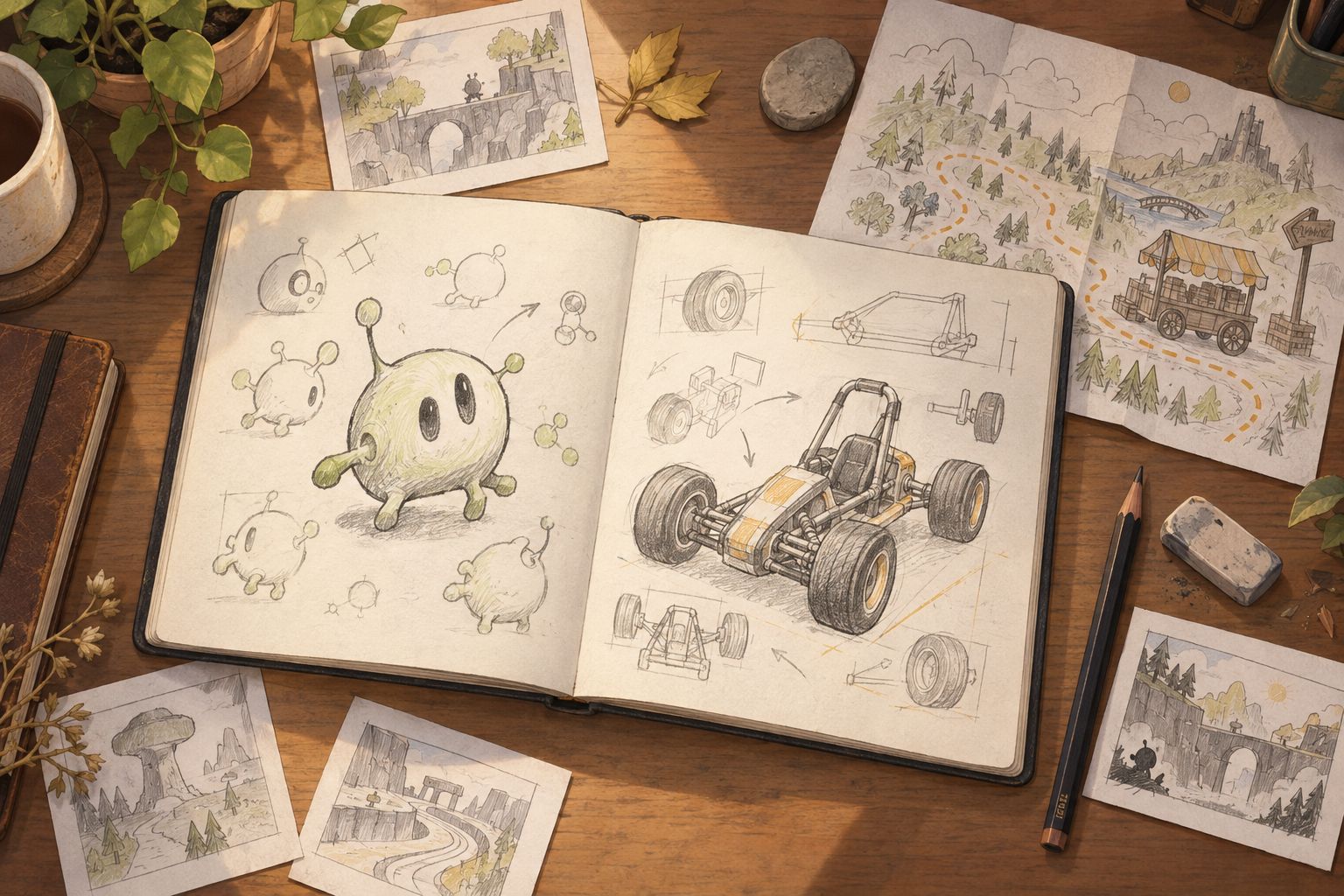
One day, we need to check whether a purchase deducts a resource twice. Another day, we need to look at a car’s jump. Then we need to figure out why a label covers a button on a narrow screen. For Almost GG, an engine is where all these different tasks need to come together into a working process.
Godot suits us because it’s open and lets us check specific changes quickly. It’s a choice for our projects and the way we work. We’re not trying to prove that one tool is automatically better than all the others for every game.
The ability to look inside
Godot is distributed under the permissive MIT license and doesn’t require royalties on game sales. Its source code is open. That’s an important basis for trusting the tool: we can study how the system works and keep control of the version we use. The license still has notice requirements that we need to follow. Godot license.
Open source doesn’t eliminate errors or do the work for the developer. It gives us the ability to investigate and choose how to solve a problem. For a small studio, it helps when a new question can be narrowed down to a specific file, scene, or reproducible example.
Repeating the tedious parts
Godot can be launched from the command line and has a headless mode for suitable tasks. These features make it convenient to build repeatable checks, imports, and builds. They’re documented engine capabilities, not a separate magic AI feature. Command line tutorial.
In our projects, these tools help us check saves, calculations, and sequences of actions. AI can prepare a script or analyze a report, and then we verify the result by running it. When we need to evaluate an image, we use an actual render: a headless check can’t tell us whether the safe area beneath a mushroom is easy to see.
Development without racing to update
Godot continues to receive new versions and fixes, as you can see in the official release archive. We’re interested in active development, but a working project doesn’t have to move to every new release immediately. We need to pin the version and check updates against our own scenes and data.
There are limits too. For example, releasing on closed consoles requires a separate route through the relevant vendors, rather than the usual built-in export for every platform. Godot’s explanation of consoles.
For us, the value comes from everyday work: change something, run it, check it, look at it, and return to the game. The less effort it takes to repeat those steps by hand, the more attention we can give to what the player will actually notice.