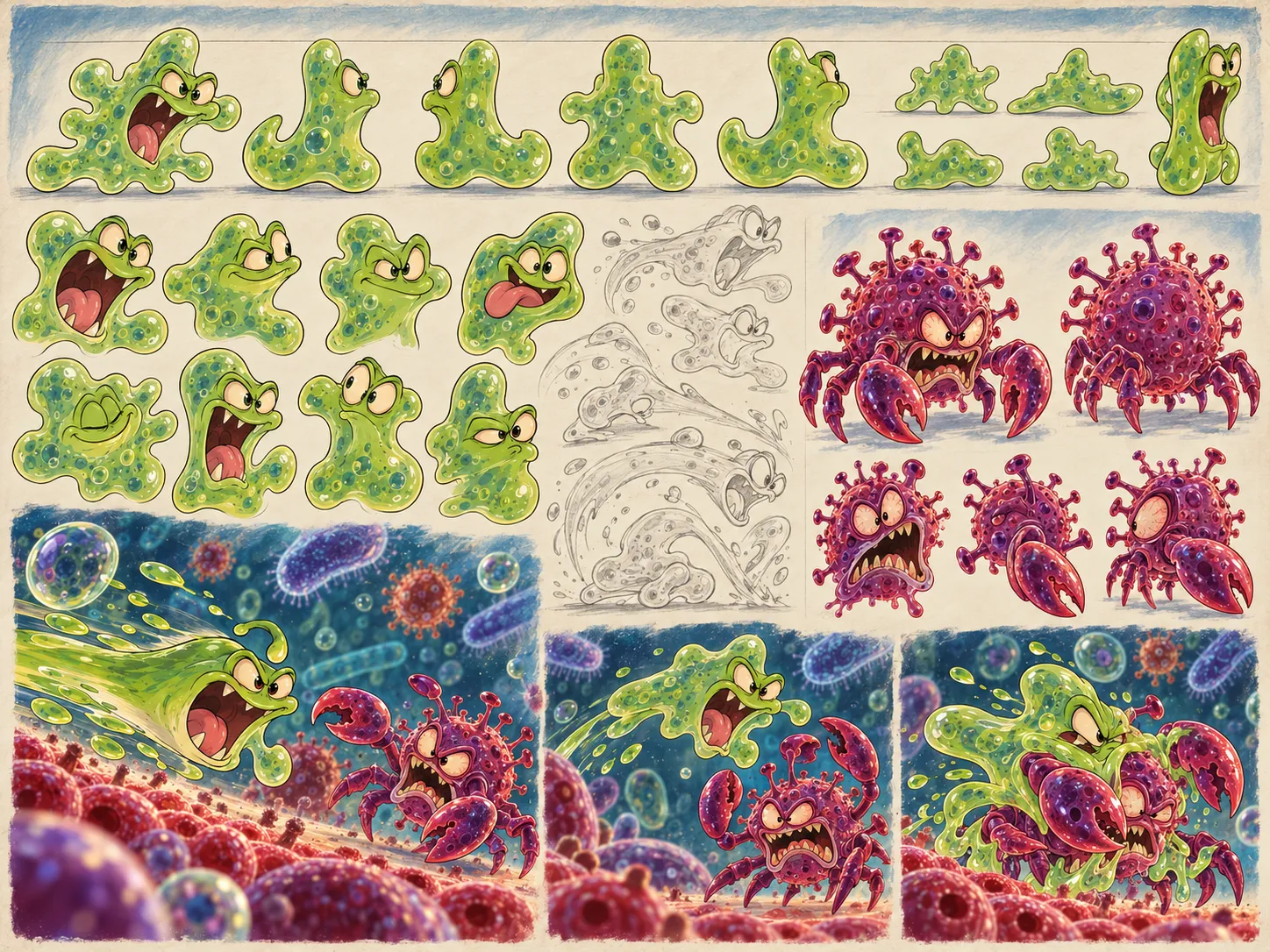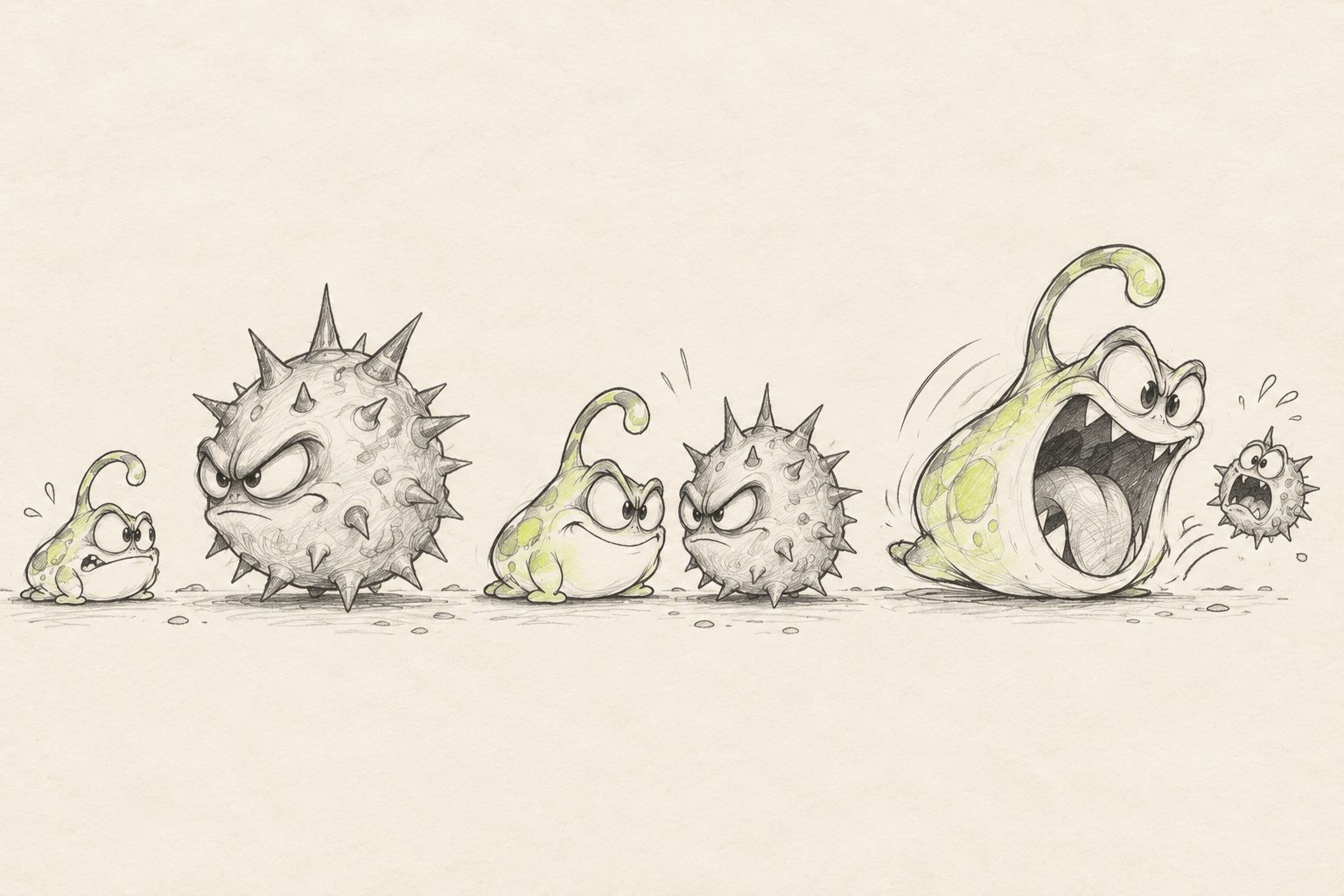
A familiar creature appears on screen. Last time, you steered clear of it. Now it has a different signal around it, it looks smaller, and Guzzle has reason to feel more confident. That shift in relationships is what the food ladder in Guzzle Boom! is built on.
At the end of September, we settled on a rule: the first three species stay as starting food, while the others gradually enter as enemies. Growth changes the role of familiar creatures. A red threat becomes yellow prey that you have to bite, then green food you can collect by touching it. This describes a decision from that stage; it isn’t a promise that the balance will stay the same in every future chapter.
One silhouette, different actions
The yellow step matters in particular. The creature is edible now, but touching it can still hurt you. So the shift from threat to food isn’t a simple “can’t” to “can.” There’s an intermediate challenge: get close enough to bite while choosing the right moment.
As Guzzle grows, the creature gets smaller relative to him. Its role in a collision changes too, so the visual change needs to match the rule. A smaller image by itself doesn’t explain anything if the old danger still applies without a clear signal.
The world doesn’t change costumes mid-encounter
There’s a less visible side to this decision. Objects already on screen don’t get replaced with a new species when Guzzle grows. Otherwise, the player would be tracking one creature and see it turn into another in the middle of the action. New inhabitants enter beyond the edge of the screen, keeping events continuous and easy to follow.
The ladder can also move backward if Guzzle shrinks. An encounter can become dangerous again. Knowing the species remains useful, but you still have to pay attention to Guzzle’s current state. You need to read his size and the signal around the creature together.
What stays outside the ladder
Bosses, walls, claws, and specific obstacles don’t become ordinary food under this rule. They have their own roles. If we applied the ladder to everything, the world would lose its stable boundaries: growth would start to suggest that you can eat any object, even though the game doesn’t work that way.
We have a finite catalog of creatures, not an endless factory for new species. The interest comes from familiar relationships changing. You remember what you feared, recognize it again, and decide whether you’ve grown enough. In those moments, progress shows up in the action itself: yesterday you had to give way; today you can try to bite your way through.