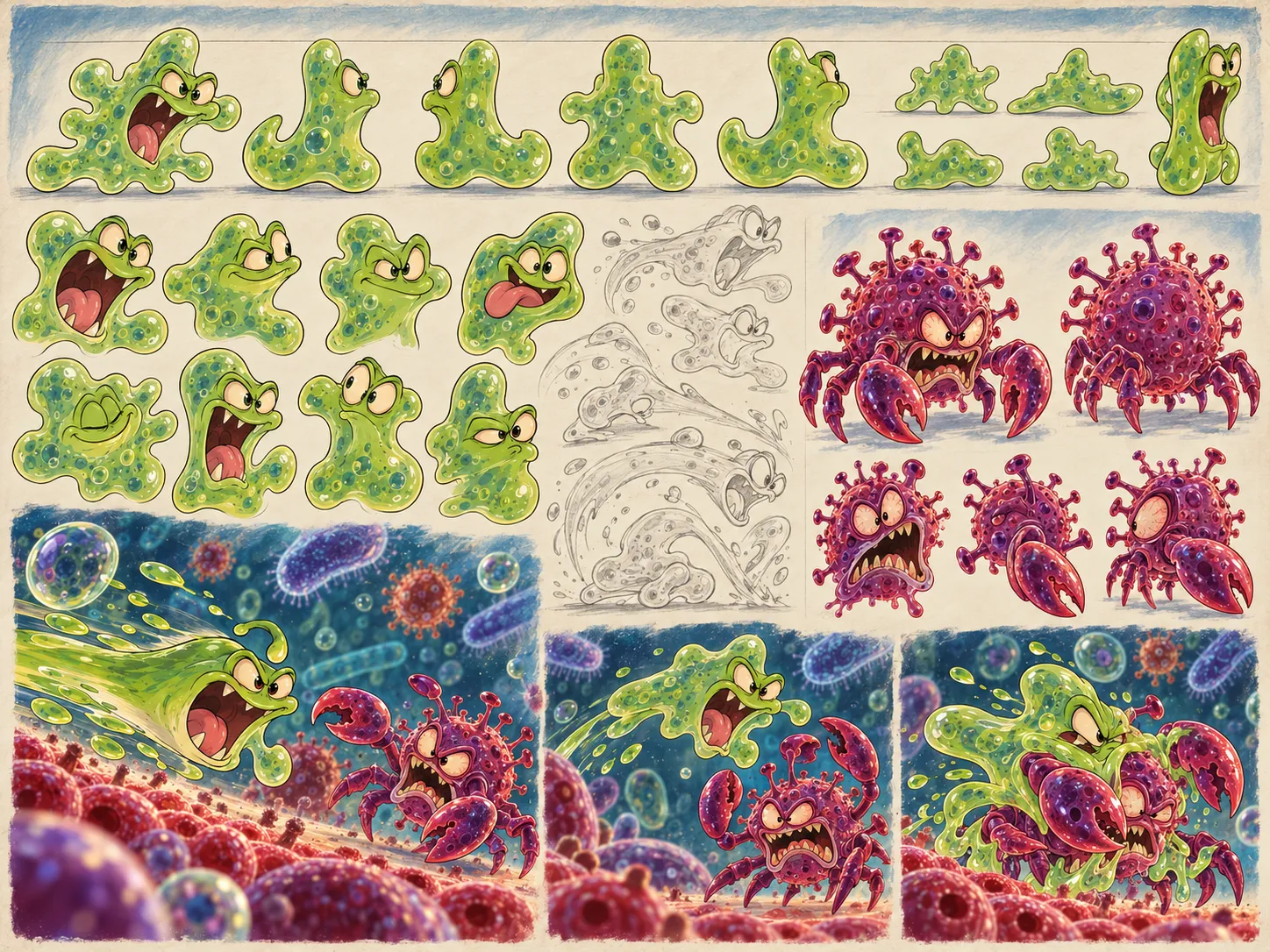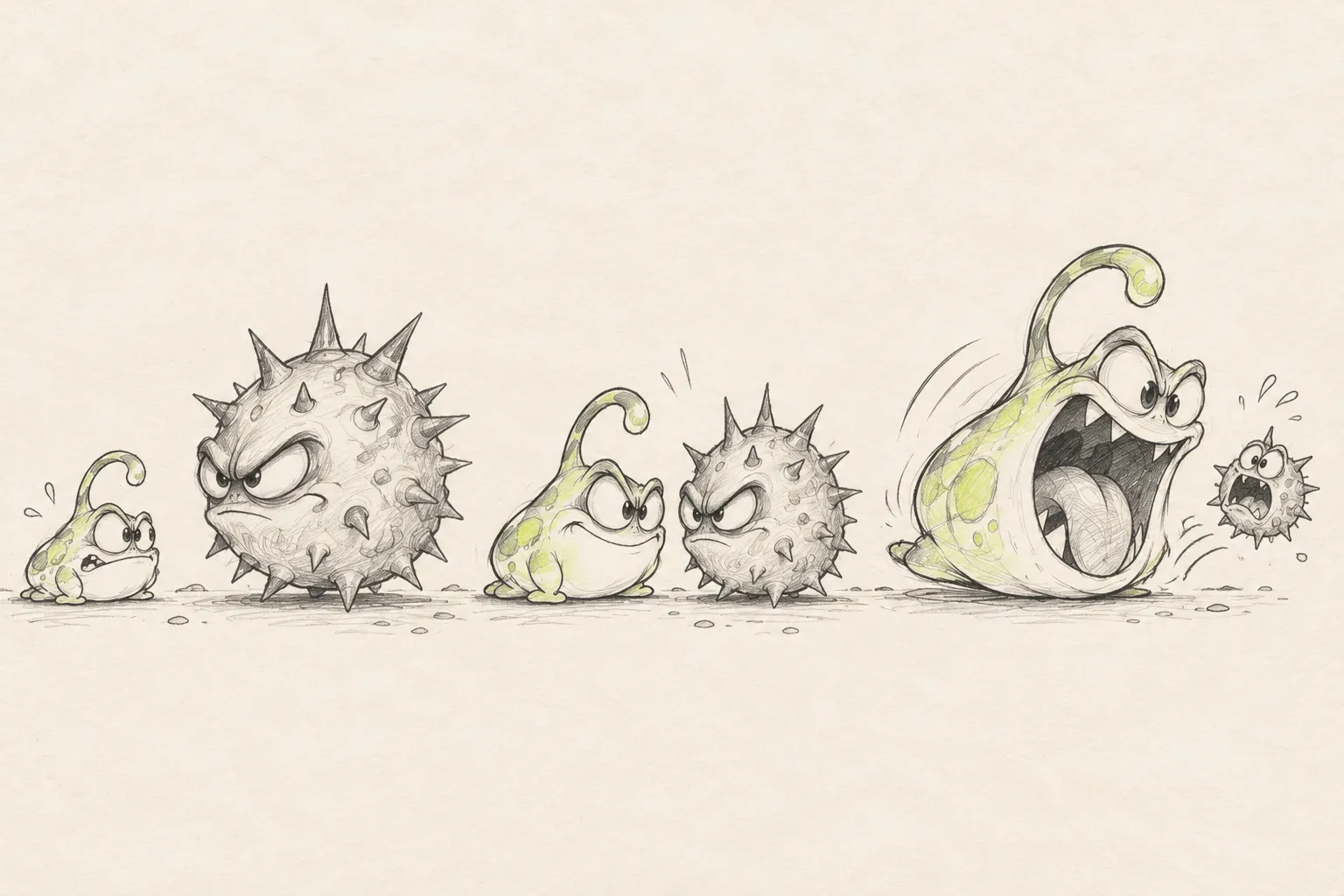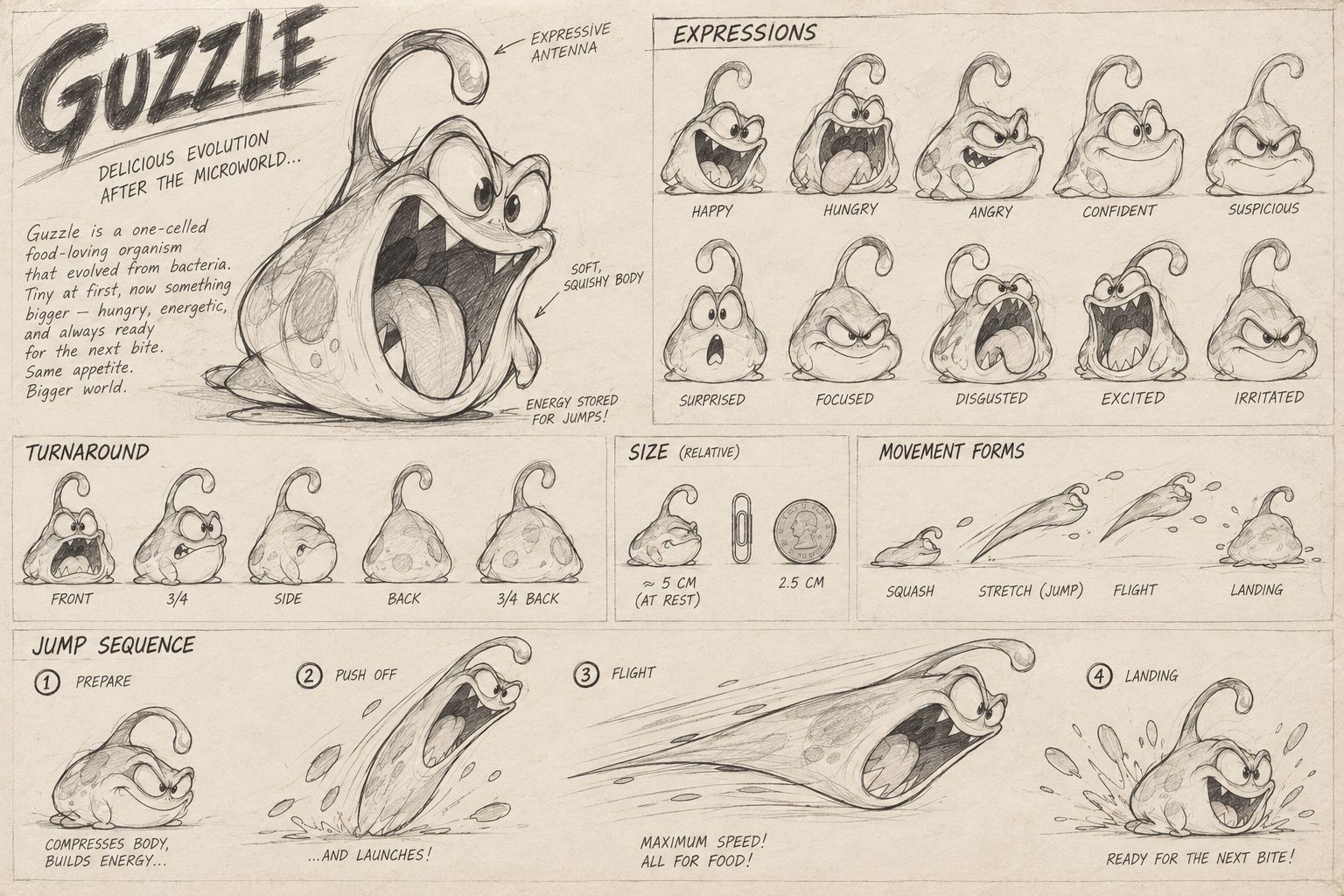
Almost everything important about Guzzle is written on his face. His huge eyes find the next target, his mouth promises trouble, and his soft body tenses before a move. You can read his character at once in a still illustration. In the game, he’s small, enemies move around him, and your finger covers part of the screen. A good drawing alone isn’t enough.
As we worked on Guzzle, we kept his green body, big eyes, and recognizable silhouette. What changed was how we presented his movement: how to show flight, distinguish the wind-up to a bite from the bite itself, and return him to his usual state after eating. This is a story about finding expression within a character we had already chosen.
The mouth has to keep up with the action
An in-game bite happens at a specific moment. The art needs to support it by showing the wind-up, the mouth opening, the hit, and the return to rest. If the most expressive pose comes late, the player sees one thing while the rule takes effect at another time. Even without knowing how the game works under the hood, that mismatch feels like a strange hit.
That’s why we tie the animation to confirmed game events. A beautiful movement doesn’t get to decide on its own whether a target was eaten. This matters especially when pausing and restarting: the body should continue the same action the game is continuing.
A big drawing and a little hero
In the art sample from early October, we checked flight, biting, and combinations of organs separately. That calls for different viewing scales. Zoomed in, you can see the outline and the joins between parts. At game size, you can check whether the mouth is still readable and whether the organs turn into visual noise around the face.
The slime gland and acid gland, along with the third eye, should feel like parts of one body. They can lag slightly behind in motion, but they shouldn’t look randomly stuck on. At the same time, development shouldn’t hide the character behind his own upgrades. The face remains the place your eyes naturally return to.
Not every sheet becomes the whole game
The archive contains separate art samples as well as materials already connected to the regular game. We keep those distinct in this series. Having a set of animation phases doesn’t mean every reaction, organ level, and transition between states has been fully made.
A pencil sheet helps us discuss character; viewing it in motion lets us test how it works. Guzzle should be recognizable both in a large illustration and in the brief moment between two dangers. We’re interested in that transition. If the player notices his hungry gaze and then understands the bite, the drawing has done more than decorate the screen.