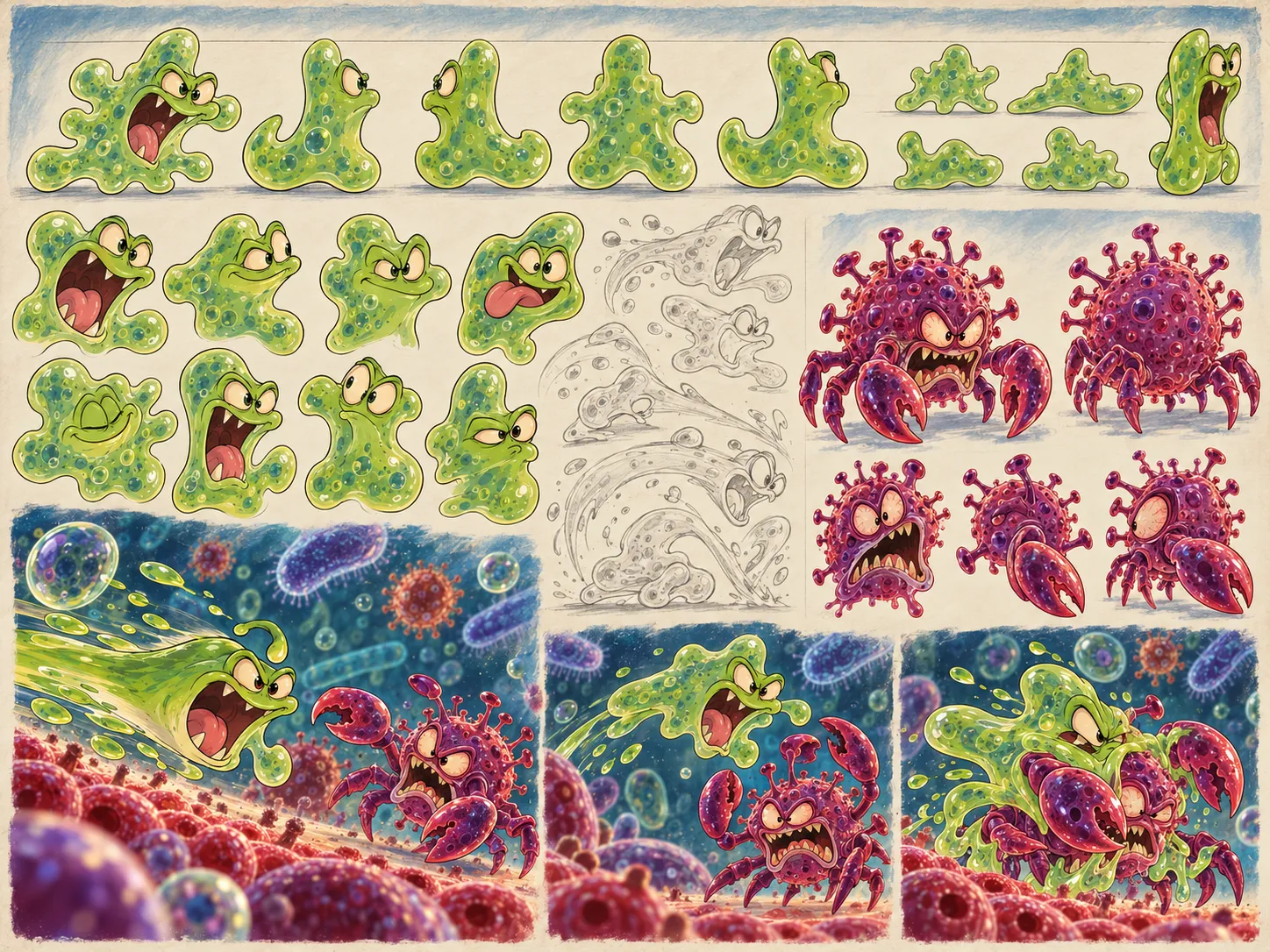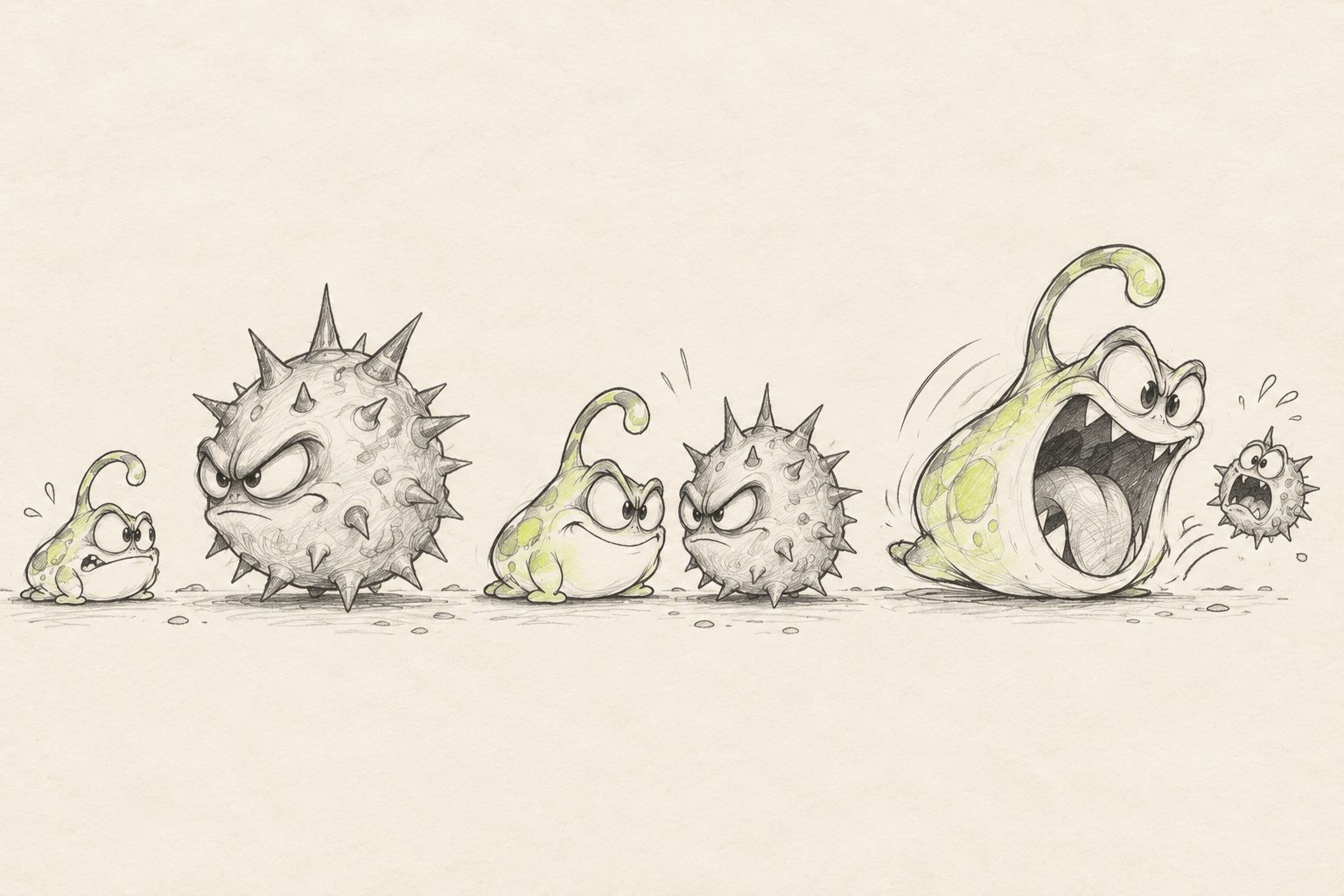
Guzzle Boom! began with a very modest goal: make a small phone game, something to get absorbed in while waiting in line. Start it, miss, try again. We had Angry Birds, Flappy Bird, and Burrito Bison in mind—games where the fun of one clear action almost immediately makes you want another go.
Then we came up with a slime that was supposed to devour the galaxy. Fairly restrained plans for our first small game.
From a cell to everything else
The original Guzzle was an all-devouring creature moving at incredible speed. Start in a microworld, fly, eat, evolve, and one day stop noticing the planets underfoot. Or, more accurately, under whatever a slime has instead of feet. We liked the shift in scale: something you were just afraid of could eventually become food.
There’s a bit of Spore in that idea—the interest in a creature that changes and, along with itself, opens up a different world. From the old PS1-era arcades, we wanted the immediacy: before you’ve had time to learn a complicated system, something is already happening, something is flying by, and you want to press again.
Evolution into a galaxy eater remained an original dream, not a promise about the current version. It helps explain the game’s appetite. Even in the early stages, though, we had a much more immediate problem to solve: how could you tell what was happening right in front of the hero’s mouth?
Speed ate the picture before Guzzle did
We tried horizontal and vertical screens. High speed, low speed, and speed that increased over time. In one version, everything moved so fast that the vivid microworld became an unreadable blur. In another, things got too calm. The slime was flying toward lunch, but there wasn’t much sense of urgency.
We had to find a workable point between those extremes. We wanted to keep the thrill of movement while giving you time to spot food, tell it from danger, and decide when to bite. Simply turning up the speed wasn’t enough; it changed almost everything about how the game felt.
More mechanics, different creatures, and phase-based bosses gradually came along. The microworld gained rules and character, and the project grew with them. This small arcade game increasingly needed to explain what you were seeing, what you could already do, and why a familiar enemy was now behaving differently.
Friends were allowed to be blunt
At some point, the doubt became hard to ignore: was this actually fun? We sent the game to friends and asked them to be completely honest. We’d rather hear what was wrong than have someone spare the developers’ feelings. After working on a game for a long time, it’s easy to see everything you meant to put into it and stop noticing what a new player can’t understand on screen.
The feedback was mixed. Some people liked it. Some found it a little boring. Some couldn’t make sense of the skills and interface. It was a small, very useful encounter between our idea of the game and someone else’s hands.
That made it clearer that Guzzle had already outgrown our original idea of a short arcade game. Going back to one button would have meant giving up part of what we’d become interested in making. We chose another direction: stay in the microworld and make it deeper, with exploration and more meaningful mechanics. That’s the direction of our current work, not a claim that everything we’ve imagined is already finished.
In an unexpected way, the story of our first game began to resemble its hero. The project ate new ideas, grew, and eventually stopped fitting in its old frame. Next, we had to decide which of its new organs it really needed. That’s what this series is about: the hero, launch, growth, the nest, and the bosses, all the way to the mushroom that gives you a good spore with some very bad consequences.