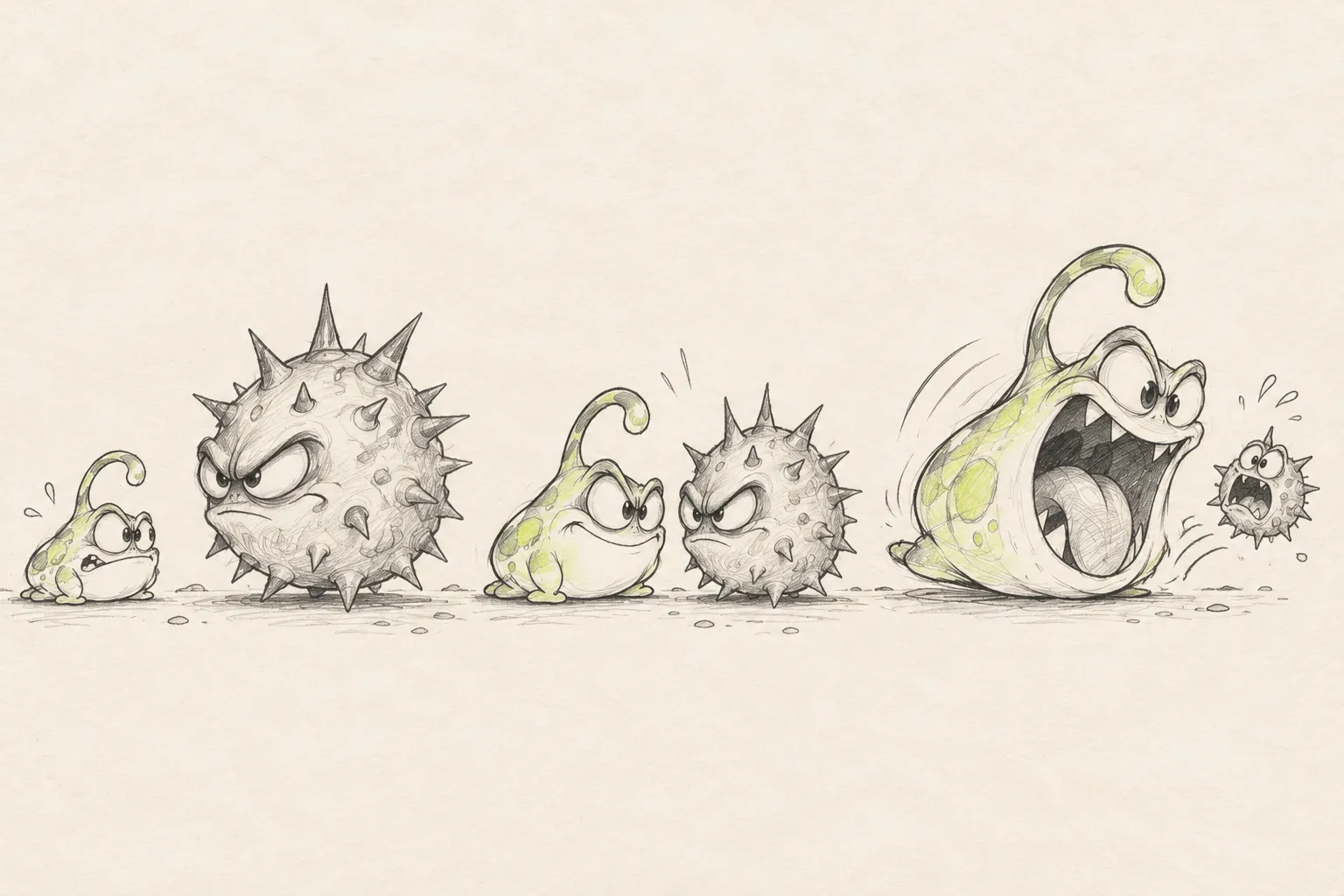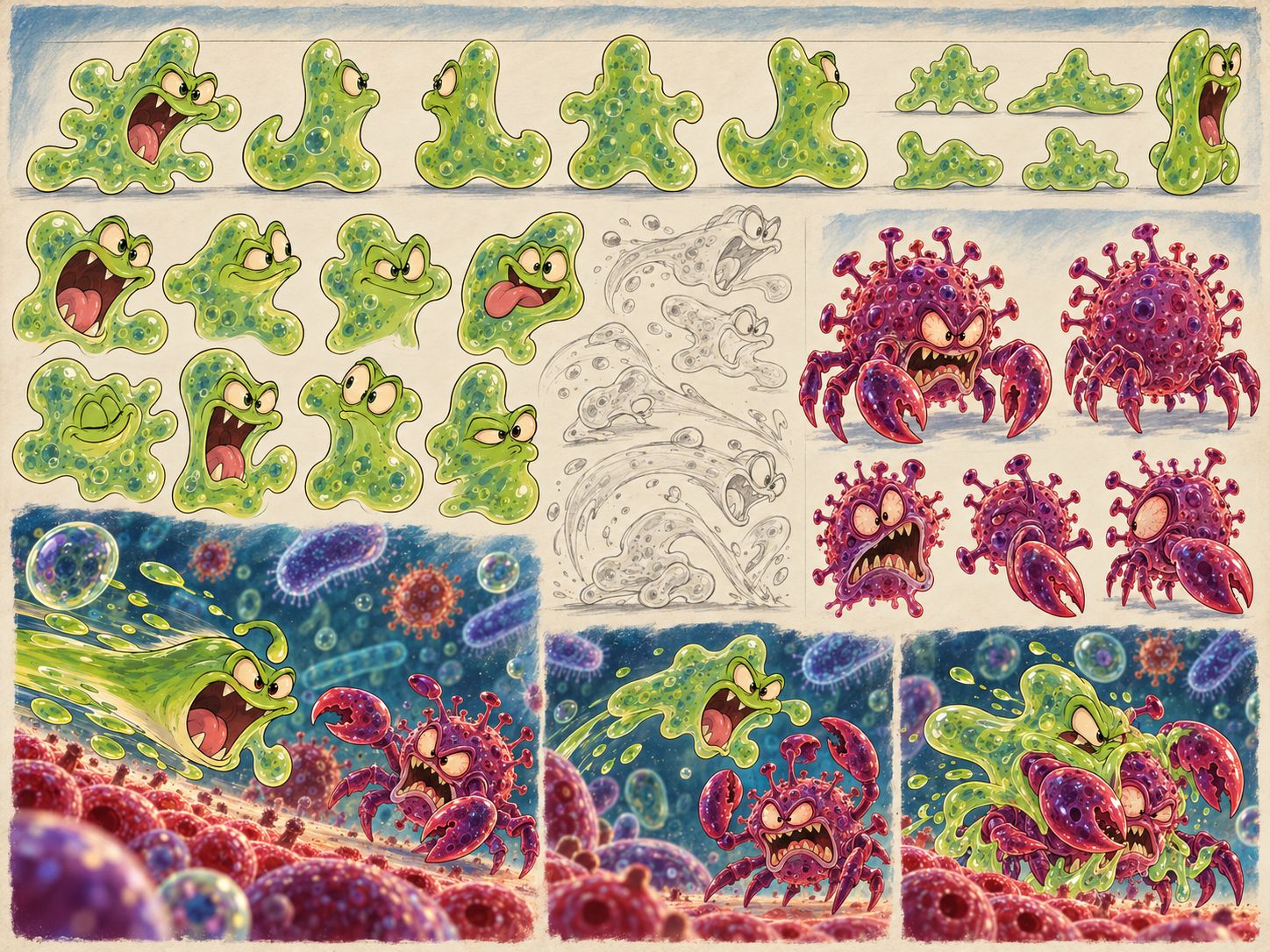
Twenty creatures can end up as twenty versions of the same nuisance. A different color, another spike, and the encounter still reads the same. In Guzzle Boom!, we needed inhabitants you could recognize by their bodies and movement while the flight continued around them.
In early October, a cartoon-style set for the microworld entered the regular game: distinct species, bosses, drawn poses, and development icons. The whole set moved to a shared visual style. Creature IDs, food values, and contact sizes stayed the same; the new art wasn’t supposed to change collision rules without anyone noticing.
Who’s looking at Guzzle?
Eyes do practical work here. A creature’s gaze helps it react to the hero instead of simply floating by like an image. Each eye has a defined area where its pupil can move. We also have to account for where the pupil was drawn to begin with; otherwise, the creature looks as if it’s always glancing in one direction.
Soft and glassy inhabitants should still feel like they have a membrane; armored and spiky ones should feel harder. Translucency can let the background show through, but the inner details still need to read clearly. If everything blends into the surroundings, a beautiful creature makes a poor gameplay target.
The art follows the game
Wind-up, attack, and reaction poses activate according to simulation states. Appendages move separately, but they don’t start their own attacks on a whim of the animation. Movement supports an event that is already happening: players see the wind-up when it actually occurs.
That limits artistic freedom in a useful way. A tentacle can sway between actions, but the moment of danger has to stay in sync. This takes special care with bosses, whose large bodies and extra parts can easily fill almost the whole screen.
The same visual language beyond flight
Drawn icons for mutations, development branches, and organs arrived with the creatures. Tap a card to open it; the effect and confirmation are inside. Opening a card to look at it doesn’t mean you’ve bought anything. That connection between expressive art and a clear action matters.
The set didn’t become a free editor for crossing any creatures together. It uses compatible parts and saved recipes. The world has artistic boundaries within which it can move and change. For us, the result of this pass is that you can tell inhabitants apart before you have to remember their names. You can see the membrane, notice the gaze, understand the wind-up, and have time to answer with a bite or a move to the side.