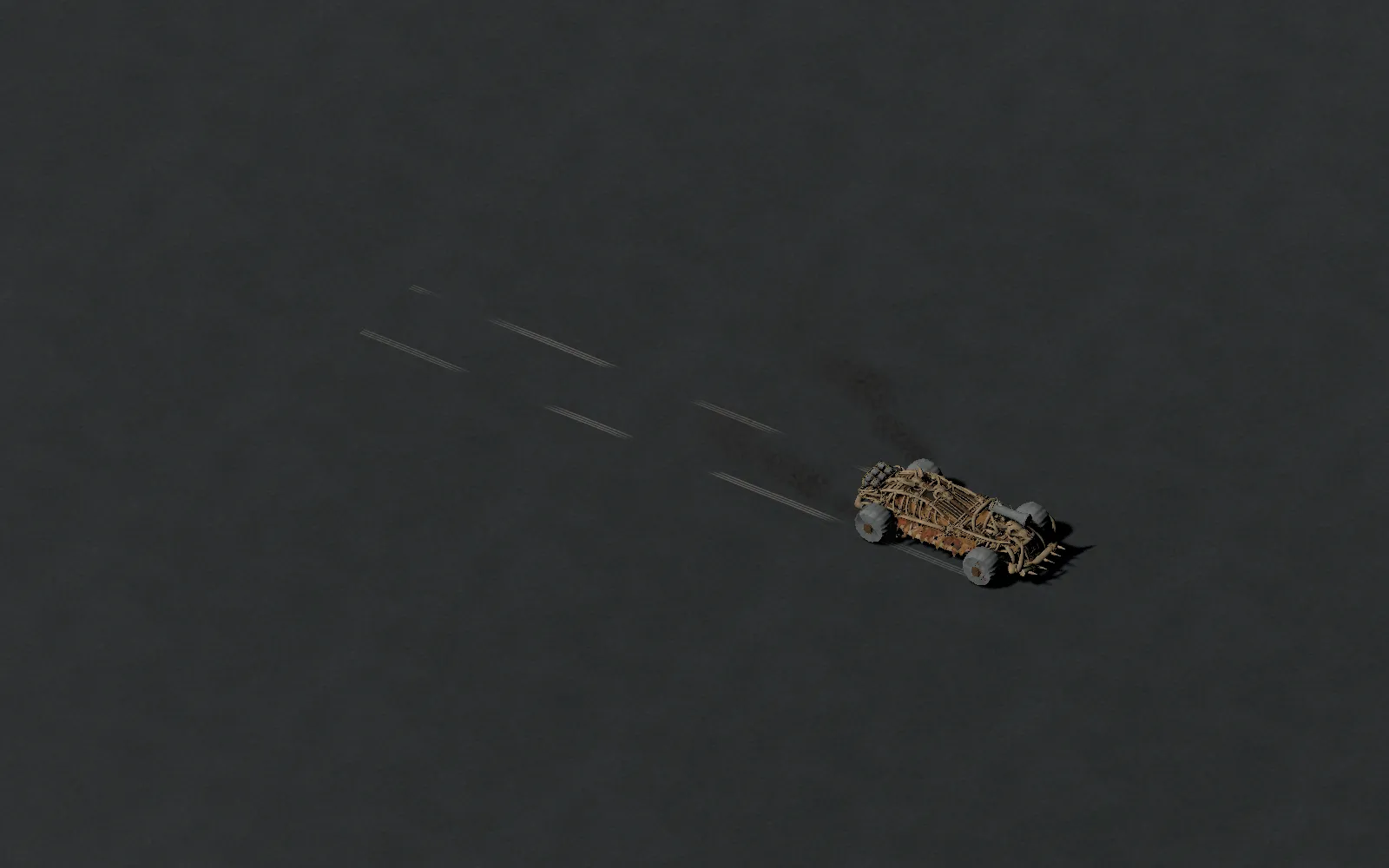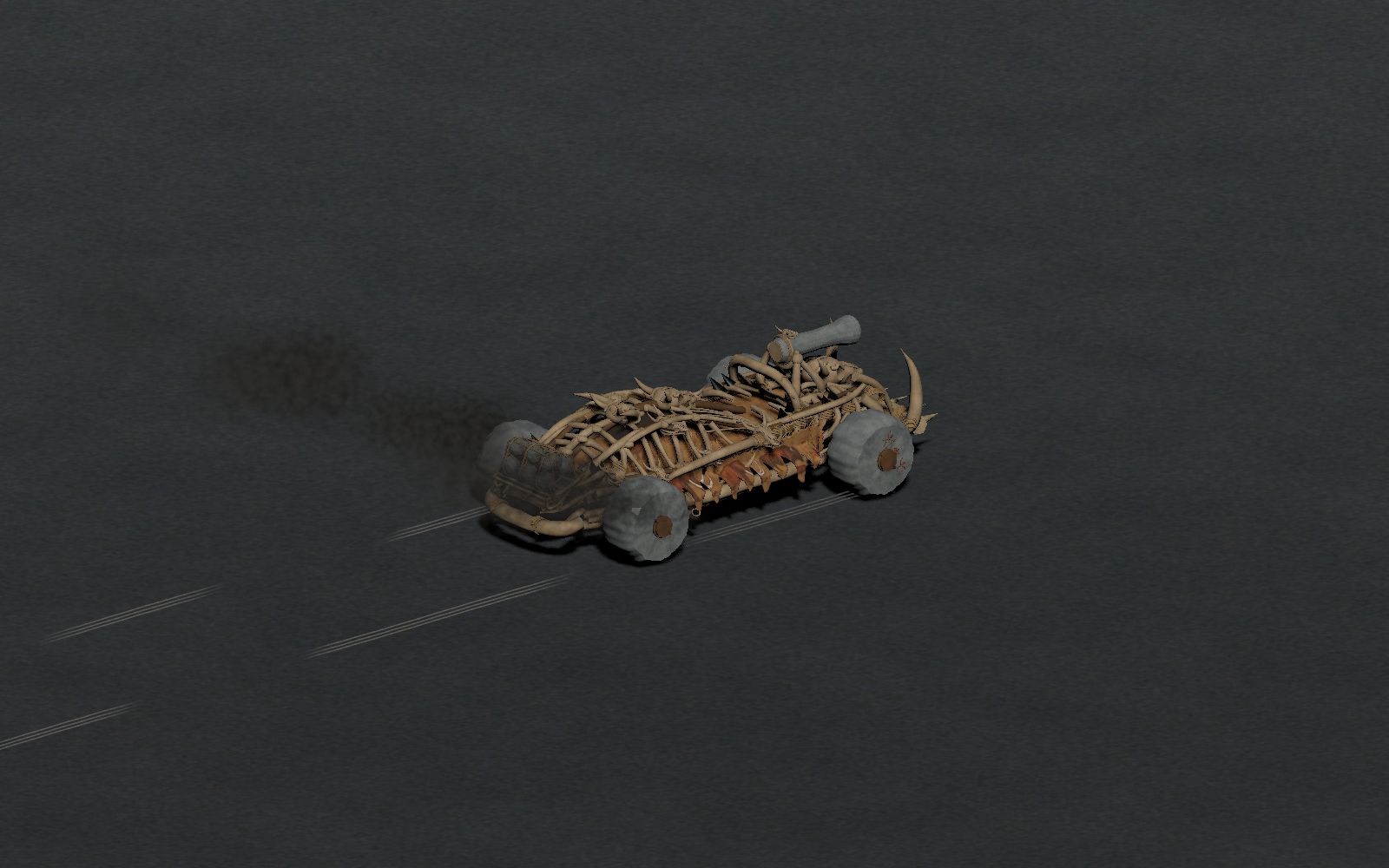
A car reference shows everything at once: silhouette, materials, details, lighting, and a flattering angle. An in-game model doesn’t get that luxury. It will be rotated, recolored, placed under different lighting, and sent onto a track where it takes up little of the screen.
In Smoke and Flame, the path from image to car runs through shape, separate parts, materials, and integration. These stages connect, but each answers a different question. A beautiful texture can’t fix the wrong body width, and good geometry alone won’t make bone look like bone.
The silhouette holds up at a distance
Wheels, body, protruding parts, and weapon placement need to read as one recognizable construction. At gameplay distance, small details disappear first. That’s why we check the overall shape before filling the image with surface details.
The bone car shows that specific refinements can still follow an approved shape. In the latest revision, the body and track width were expanded, and the stone wheels became bulkier. This was a limited proportion change to an existing design, not a new car built from scratch.
Details need to work
A wheel rotates around an axis, a weapon appears at its intended point, and an effect comes from the exhaust pipe. A model depends not only on visible surfaces but also on the points where its parts move or trigger gameplay events.
Integration checks several equipment combinations. Something that looks right on an empty car may intersect an installed part. Those errors are easy to spot in the garage, but they also need to be checked in motion, as the body turns and tilts.
The same car in several places
The garage, race, icons, and selection images should all show a consistent version. Otherwise, the player chooses one shape and gets another on the track. That’s why some images are recaptured from the in-game model after changes.
There’s no moment in this story when a beautiful render automatically becomes a finished car. There’s a sequence of checks: does the construction read clearly, are the parts in the right places, does the material work, and does the appearance match the action? Character comes from how these pieces fit together. The body can be funny, rough, or threatening, but on the road it still has to sit convincingly on its own wheels.