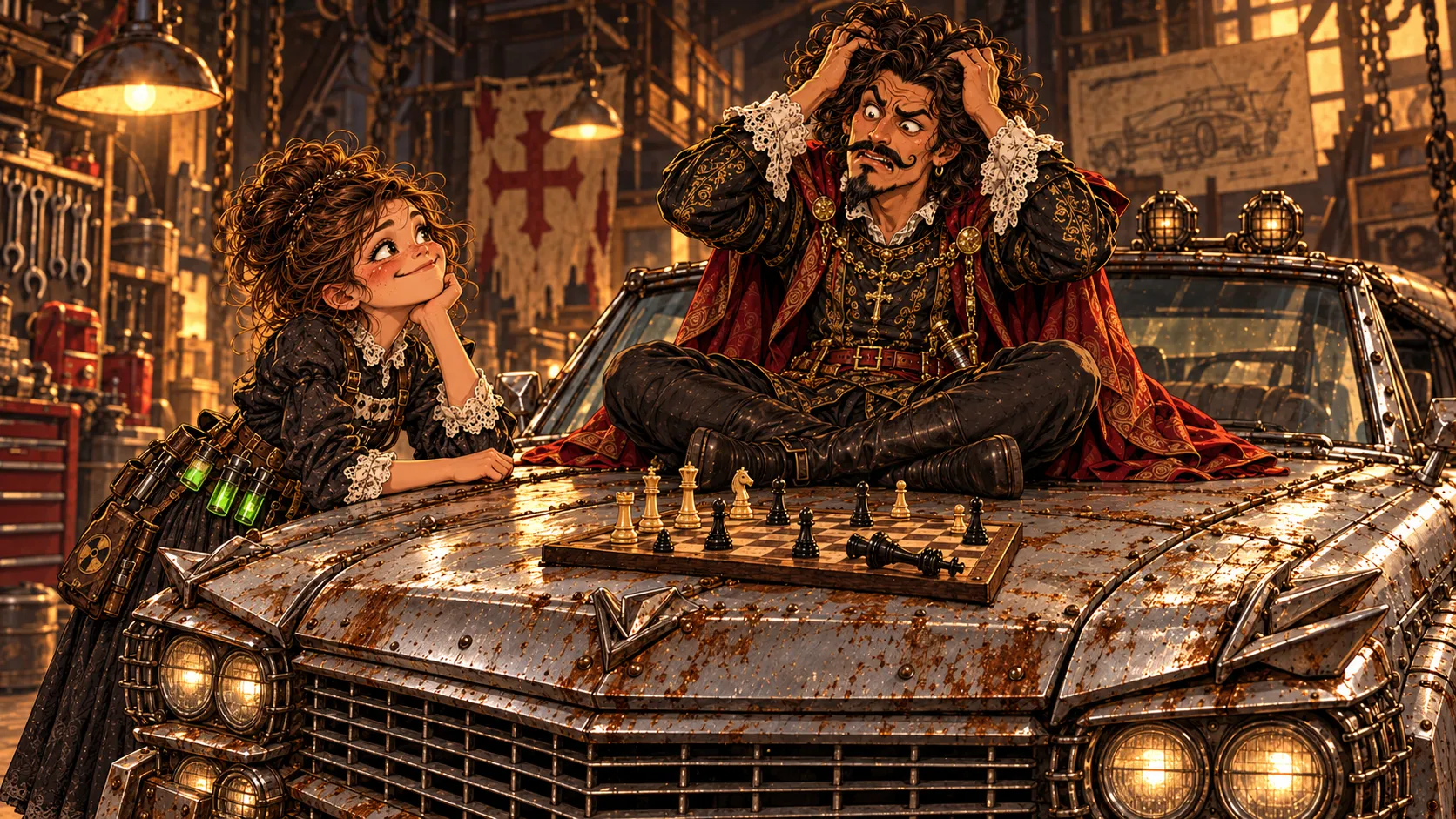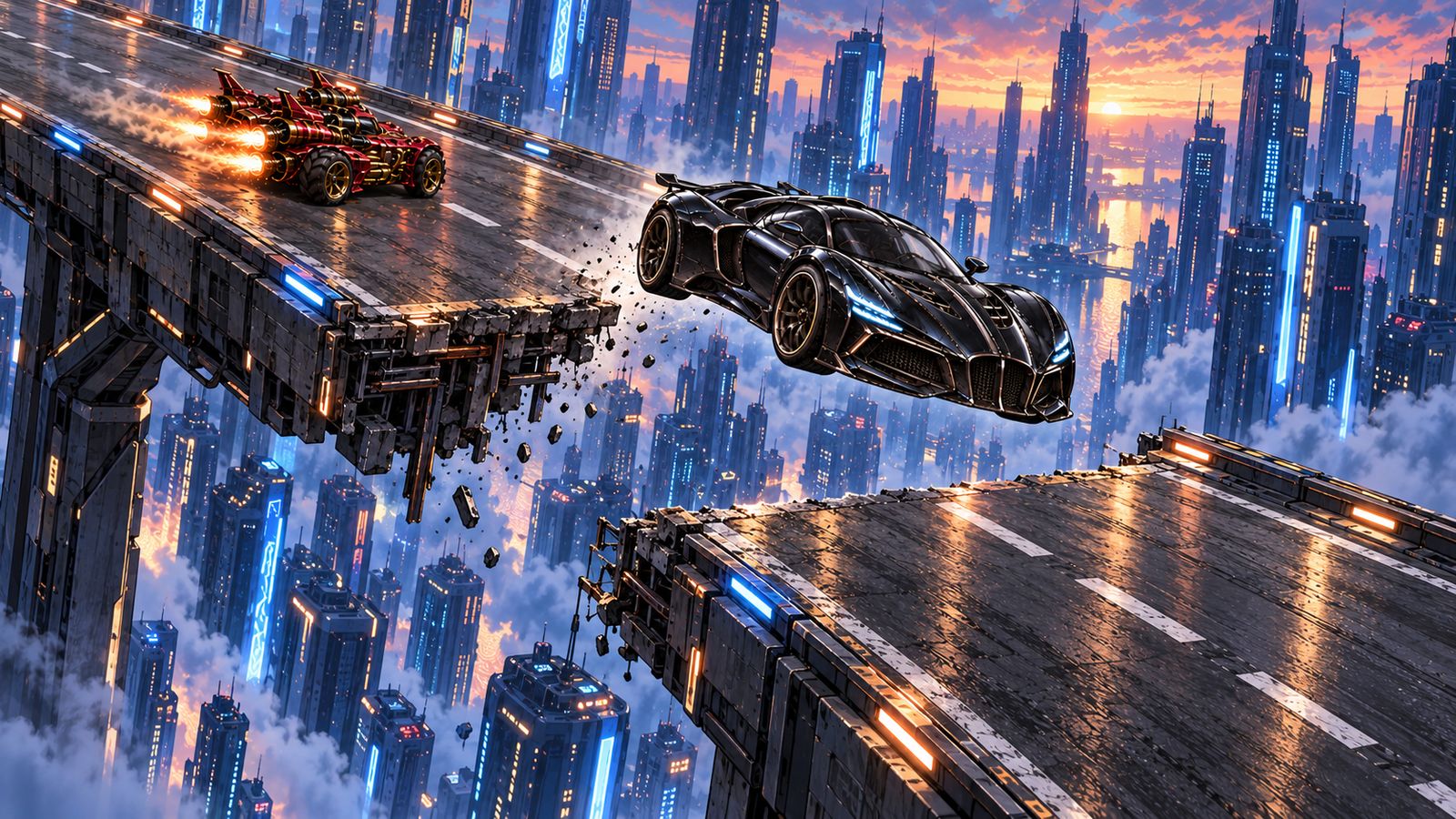
An early car may not have convincing paint, polished pipes, or a finished body. It still has to respond to the steering, pass through the track gates, and recover from a mistake. In the Smoke and Flame prototype, simple shapes let us separate how a race worked from the details of its eventual art.
Before that, we had to give up an even more convenient placeholder: just make a racing game modeled on the kart racers we loved. Mario Kart and Crash Team Racing already offered the experience that made us want to play them again. Copying that desire wasn’t enough. We started looking for a combination of cars, combat, and heroes that would make our own project worth building.
The working documents point to a very practical next step: use simple placeholders and connect the opening of the game first. More detailed car references already existed alongside them, but building every body didn’t replace testing the player’s path through the game. The wild race we imagined still had to make it around one ordinary lap convincingly.
You have to be able to drive the lap
A race takes more than moving a car to the finish. Gates determine the order of the route; a fork has to respect the road you chose; and returning after going off track can’t count a missed section as completed. These rules are easy to miss when they work properly.
Early revisions even clarified what should happen where two branches of the road still overlap. The nearest road axis doesn’t necessarily mean the player has chosen a turn. Locking the route too soon can send the car down the wrong path while it’s still in the shared section of road.
Control has to work after a mishap
After a collision and recovery, you want to get moving again. Continuous inputs—accelerator, brake, and steering—need to stay in sync with your controls. A one-shot weapon, by contrast, shouldn’t fire just because its button was held before a pause.
Losing focus or a controller calls for extra care. Returning to the window shouldn’t send the car into a wall unexpectedly. These cases are checked by requiring neutral input and an explicit restart. That’s part of how the controls feel, even though it won’t show up in a promotional image.
A placeholder answers one question
A simple body is useful while it lets us test movement and the sequence of actions. It doesn’t confirm the final art. A detailed model, in turn, can’t fix a broken recovery or an unclear fork.
So we show the early prototype in this retrospective without presenting it as the game’s current look. It shows which questions came before the finish work. Once the basic lap works, the future car has a stable place in the game: a clear road, a controllable turn, and rules for mistakes. Then the body can express character instead of distracting from a race that still doesn’t know how to end correctly.